
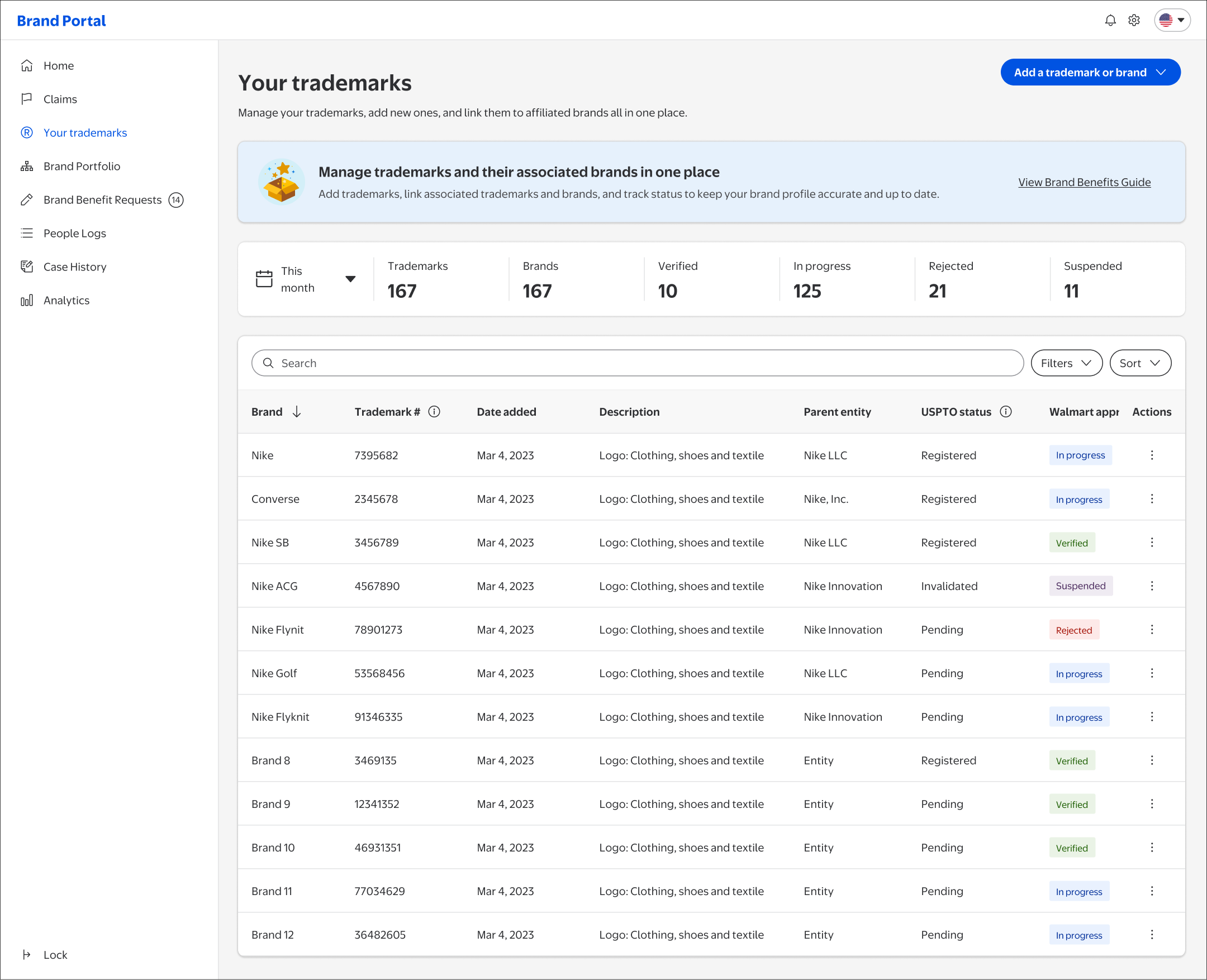
Brand Portal is a critical platform that enables brand owners to verify ownership, manage trademarks, and protect their presence on Walmart Marketplace.
I led the design of the Trademark & Brand Management experience, helping users to register trademarks, understand brand relationships, and maintain a complete brand profile.
Brand Portal — Trademark & Brand Management
Role: Product design lead - Solo designer
Scope: Seller Center · Brand Portal · Walmart Connect · Marketplace Learn
Timeline: 3 months
Responsibilities
Reviewed and refined PRDs to ensure clarity, feasibility, and alignment with user needs
Facilitated cross-functional discussions between product, business, and engineering teams
Aligned perspectives and drove decision-making on product direction
Conducted research to identify gaps in tool adoption, user behavior, and workflow fragmentation
Synthesized insights to create product strategy and the user experience design
Drove AI-driven enhancements to improve content optimization and increase the speed of completion rate, enabling intelligent recommendations within the seller workflow
Identified opportunities to integrate intelligent recommendations into the brand experience
Translated discussions and insights into scalable design solutions
Iterated designs based on continuous feedback and evolving recommendations
Presented final design solutions to stakeholders for alignment
Final development handoff
Project Goal:
Centralize brand management
Create a unified destination where brand owners can manage trademarks, brands, and their relationships across systems. Eliminate fragmented workflows and reduce the need to navigate between multiple tools, enabling a more efficient and cohesive brand management experience.Improve visibility
Provide clear, real-time visibility in trademark lifecycle states (e.g., pending, verified, rejected, suspended). Enable users to quickly understand approval progress, identify issues, and take appropriate actions without relying on manual tracking or external communication.Simplify complex workflows
Streamline the trademark registration and management processes by reducing unnecessary steps, adapting flows based on user context (e.g., pending vs registered trademarks), and minimizing cognitive load. Make a legally complex process more intuitive and accessible for users with varying levels of access.Enable scalable usage
Design a flexible system that supports both small-scale sellers and enterprise brand owners managing large portfolios. Ensure the experience scales effectively with increasing data volume through features like bulk actions, structured data views, and efficient navigation patterns.
Key Objectives
Provide a status-driven dashboard for tracking the trademark lifecycle
Design a centralized dashboard that shows trademark statuses (e.g., pending, verified, rejected, suspended) as the primary organizing principle. Enable users to quickly assess overall brand health, identify bottlenecks, and prioritize actions without needing to manually track progress across systems.Design a dynamic registration flow for USPTO pending and registered trademarks
Create a flexible form experience that adapts based on trademark type, requiring only relevant information for each scenario. Support both single and multiple trademark entries, while ensuring accuracy through validation and structured inputs to reduce submission errors and re-submissions.Enable bulk actions and multi-entry support for efficiency
Allow users to manage multiple trademarks and associations in a single workflow. Introduce bulk selection, editing, and submission capabilities to reduce repetitive tasks and improve efficiency for users handling large trademark portfolios.Display brand relationships and parent entities to support decision-making
Create connections between trademarks, brands, and legal entities directly within the interface. Help users understand ownership structures and relationships at a glance, enabling faster and more informed decisions around brand authorization and management.Introduce intelligent recommendations to help users discover associated brands and trademarks
Leverage system signals (e.g., entity matching, naming patterns, historical data) to suggest relevant brand and trademark associations. Provide clear explanations for recommendations to build user trust and assist users who may not have full visibility into their brand ecosystem.Embed guidance and education within the workflow to reduce errors and confusion
Integrate contextual guidance, tooltips, and explanatory content throughout the experience. Clarify requirements, explain approval processes, and highlight benefits, reducing reliance on external documentation and improving task completion rates.
Conversion & Adoption
+27%
Higher registration completion rate
-30%
Reduction in support tickets
+15%
Increase in ad purchases
-30%
Form drop-off rate
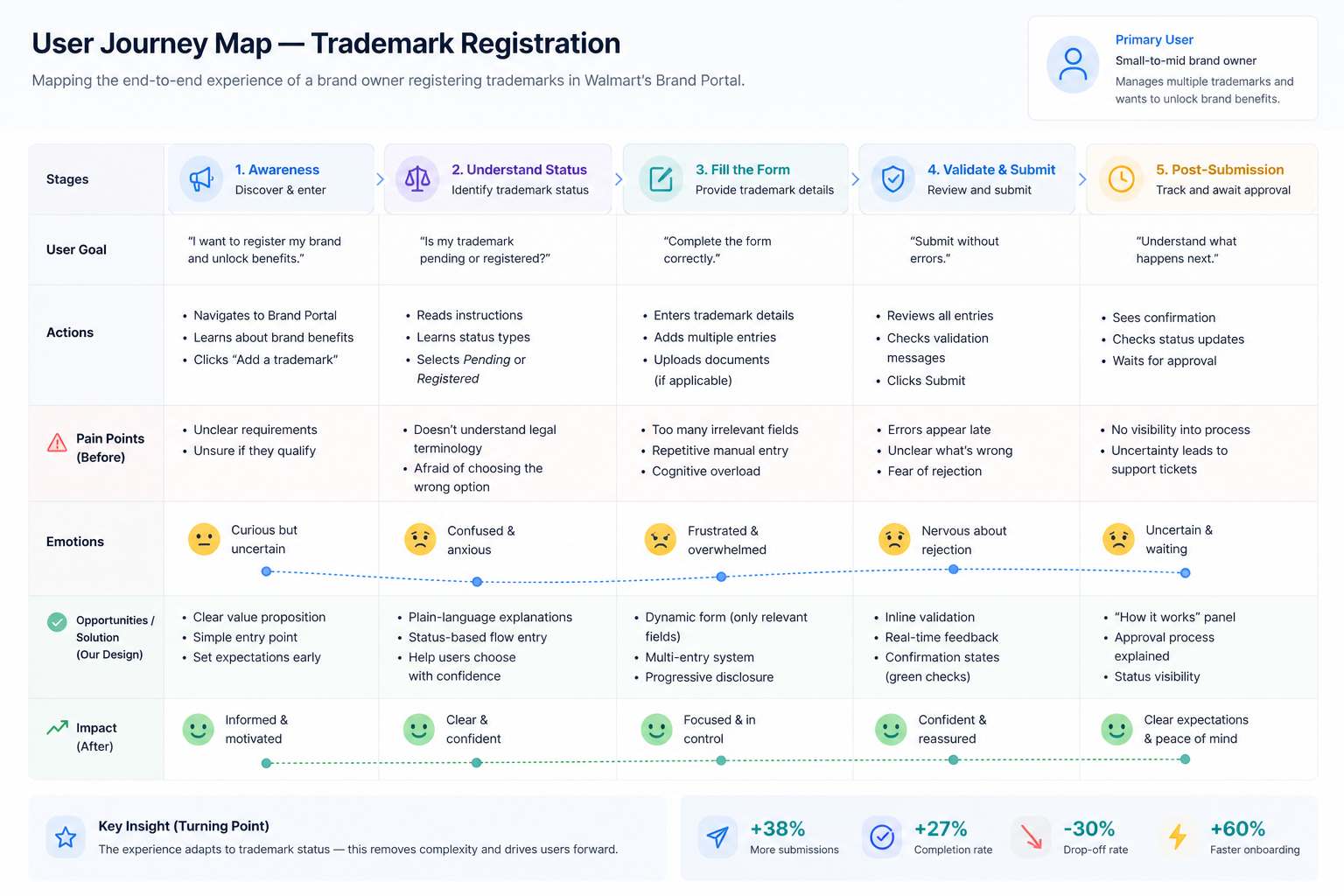
This user journey map captures the end-to-end experience of brand owners registering trademarks in Walmart’s Brand Portal, from initial intent to post-submission.
It highlights a critical breakdown early in the journey: users struggle to understand their trademark status (pending vs registered), which leads to confusion, hesitation, and incorrect inputs. This uncertainty cascades into later stages, where users face overwhelming forms, repetitive manual entry, and late-stage validation errors—ultimately resulting in high drop-off and increased support requests.
By mapping actions, pain points, and emotional states for each stage, a key insight emerged: trademark status is the primary decision driver for the entire experience.
This insight directly informed the design of a status-aware, dynamic registration flow that adapts to user context, surfaces only relevant inputs, and provides real-time feedback. Combined with multi-entry support and embedded guidance, the redesigned experience reduces cognitive load, improves submission accuracy, and increases user confidence throughout the journey.
The journey map also illustrates how targeted interventions at key friction points transform the overall experience—from uncertainty and frustration to clarity and control—ultimately driving higher completion rates and faster onboarding.
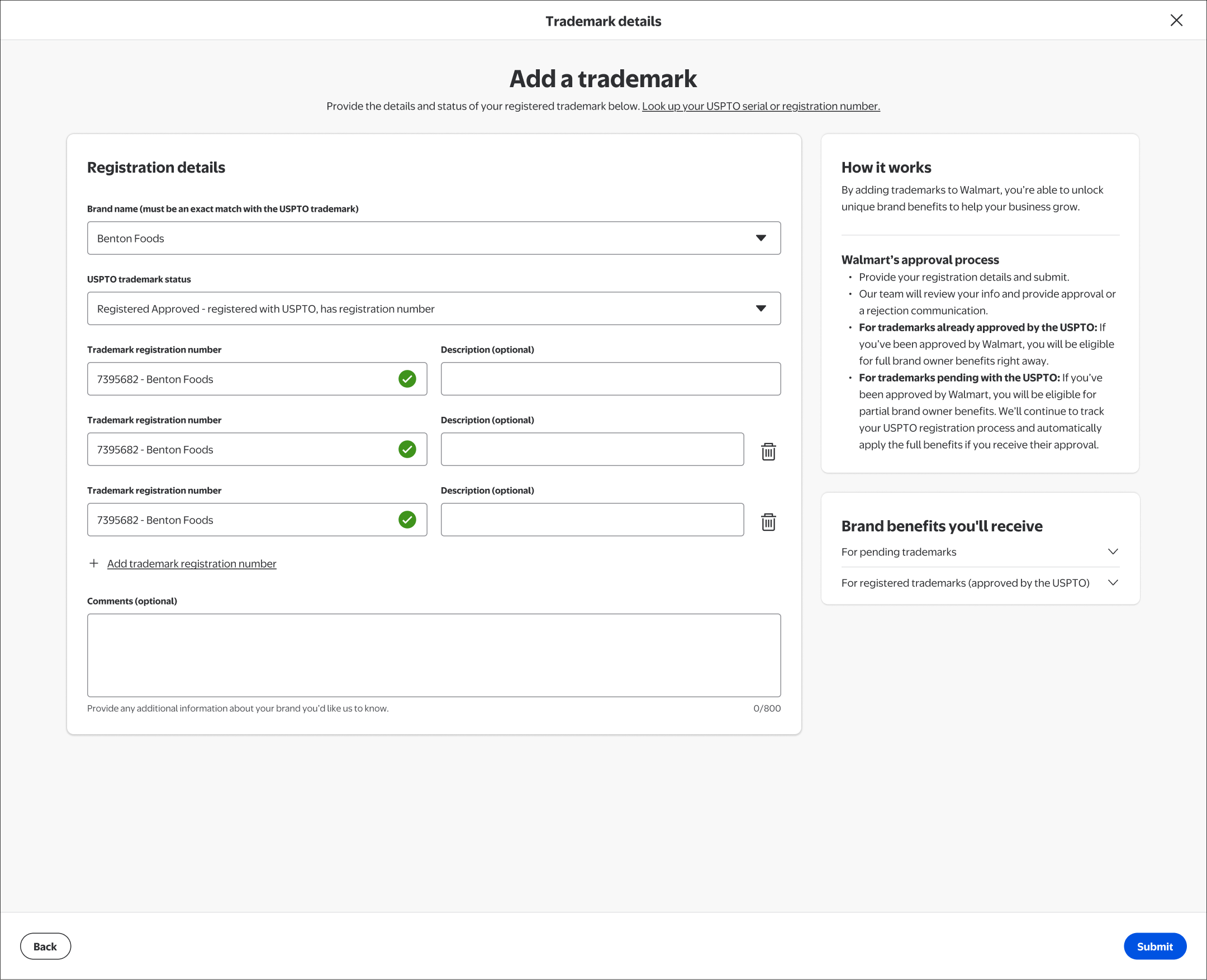
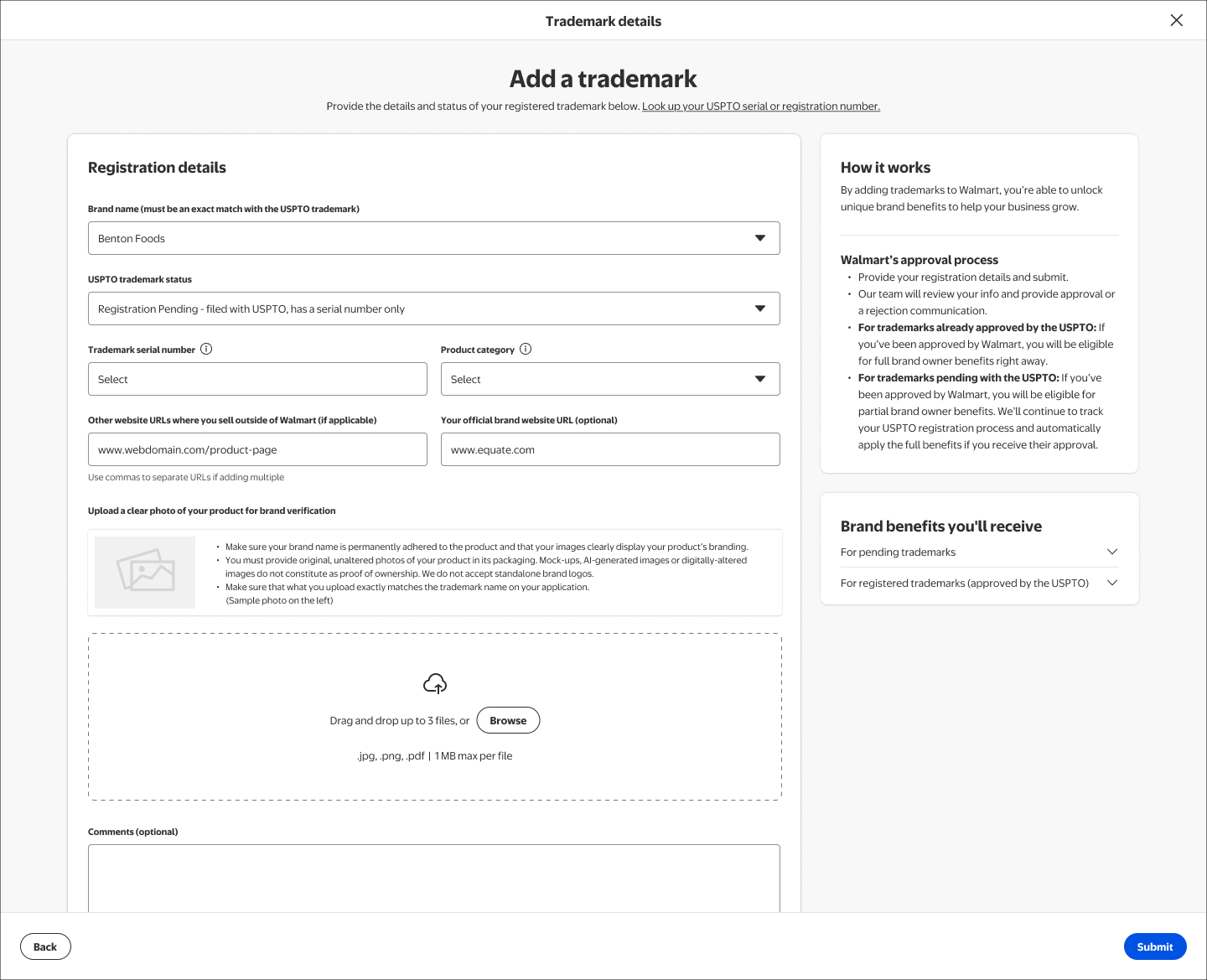
Designed a trademark registration flow that simplifies a complex legal process for brand owners. The experience is adapted based on trademark status (pending vs registered), reduces unnecessary inputs, and supports multiple entries in one flow. Clear validation and built-in guidance help users complete submissions with confidence, improving accuracy and completion rates while speeding up brand onboarding.
Problem
Brand owners struggled to:
Understand what trademark status they had (pending vs registered)
Know what information is required
Complete submission without errors
Manage multiple trademarks efficiently
Result: low completion rate, confusion, and delayed brand onboarding.
My Design Approach
I designed a status-aware, progressive registration system:
Dynamic form behavior
Different inputs for Pending vs Registered trademarks
Reduces cognitive load and irrelevant fields
Multi-entry system
Users can add multiple registration numbers
Supports real business workflows (brands rarely have just one)
Inline validation + confirmation
Immediate feedback (green check states)
Reduces submission errors
Contextual guidance (right panel)
“How it works” + approval process
Sets expectations → reduces anxiety and support tickets
Key UX Decisions
Different flows for different statuses
Show only relevant fields for pending vs registered trademarksShow only what’s needed
Keep the form simple and avoid overwhelming usersSupport multiple entries
Let users easily add more registration numbersBuild trust through feedback
Use validation and familiar terms to increase confidenceGuide users within the flow
Provide help directly on the page to reduce drop-off
Final takeaways
By aligning the experience with trademark status, we transformed a complex legal process into a structured, scalable workflow that increases completion, reduces errors, and accelerates onboarding. I led the design of a trademark registration experience in Walmart’s Brand Portal. The problem was that users didn’t understand their trademark status, and the system showed the same complex form to everyone, which caused high drop-off and errors. Also, the brand owners can register a brand with a pending trademark to reduce the 12-month wait time with the USPTO approval process.
I introduced a status-aware, dynamic flow that adapts based on whether a trademark is pending or registered, along with multi-entry support and inline validation.
As a result, we saw a 38% increase in submissions, 27% higher completion rate, and 60% faster onboarding.
The key insight was that once the experience aligns with trademark status, the complexity naturally simplifies.